

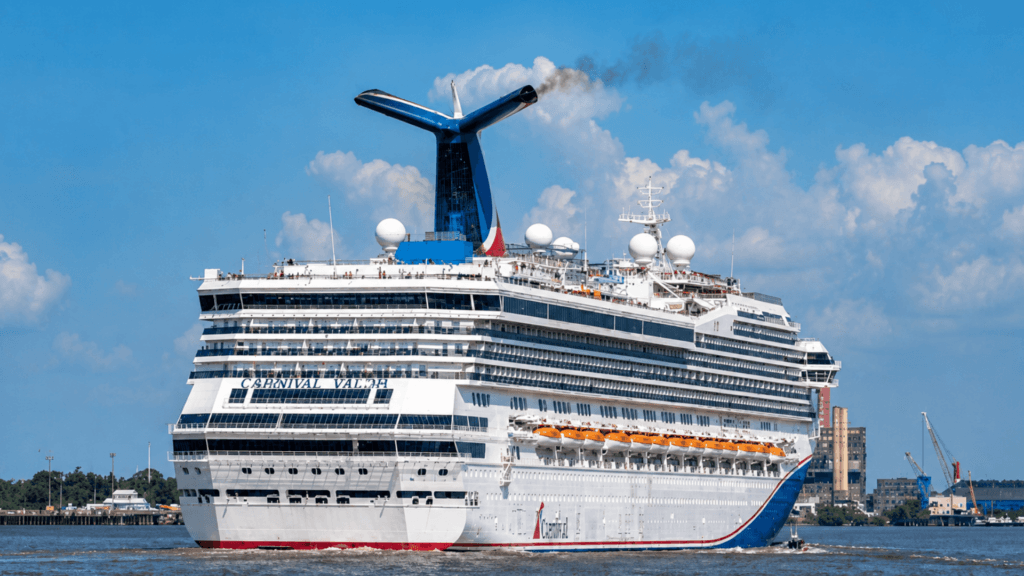
Brian Keith, a Louisiana traveler known online as @briankeithw, walked up to the Port of New Orleans ready for a Western Caribbean cruise. Carnival staff looked at the birth certificate he had carried onto ships for more than a decade and told him it would not work. “My birth certificate that I’ve had for almost 60 years and used for everything my entire life is no good for a cruise,” he said in a video that has now drawn over 120,300 views.
He had used the same document just months earlier without issue. This time, staff flagged something about the certificate itself and refused to let him or his partner board. The couple stood at the terminal, watching other passengers move past them toward the gangway, while their vacation collapsed before it began.
What followed turned into a drawn-out ordeal involving lost luggage, a hotel mix-up, and a fight over money that Brian says Carnival still has not resolved. He posted the whole account, and thousands of commenters weighed in with their own theories, warnings, and travel horror stories of their own.
Four Hours, One Suitcase, and an Escort Out the Door

Once Brian and his partner were denied boarding, their checked bags still had to come off the ship. That process alone took close to four hours. When it finally ended, only one suitcase came back. “Got all of our shoes in it,” Brian said, “so we’re going to be wearing shoes around our necks tomorrow.”
Everything else, including their clothing, stayed on the ship. “Wait a whole week or so to get my clothes back from Carnival,” he said. “But my clothes got to go on the cruise. I hope they take pictures.” The remark captured the frustration of watching their belongings sail off without them.
Brian said staff then walked the pair out of the terminal in a way that felt punitive. “They escorted us out like we’re a couple of common criminals,” he said. From there, the day turned into a scramble: an Uber back to his truck, forty dollars for parking, and a hotel search in New Orleans.
The first hotel room he booked was unmade with an overflowing trash bin, forcing him to queue again for a second room. By evening, the couple ended up on Bourbon Street eating nachos, trying to salvage what was left of the trip. Brian summed up the mood as an attempt to “just start living our life again like normal.”
The Seal Theory Commenters Pushed, and What Carnival’s Own Rules Say

In the comments, people pressed Brian for specifics on why his certificate failed. He explained that he had both a driver’s license and the birth certificate, and that the cruise, departing New Orleans for the Western Caribbean, did not require a passport. “They stated my BC was not acceptable this year that I’ve used 10+ years,” he wrote. “This year stated about the seal on the BC.”
Hundreds of commenters insisted a raised state seal is mandatory for a birth certificate to work at a cruise terminal. Carnival’s own travel documentation guidelines do not support that claim. The policy accepts a copy of a birth certificate issued by a government agency and states plainly that it does not need to be notarized or certified. No seal requirement appears anywhere in the listed rules.
Federal guidance points the same direction. U.S. Customs and Border Protection’s Western Hemisphere Travel Initiative rules allow a citizen on a closed-loop cruise, one that departs and returns to the same U.S. port, to present a government-issued photo ID along with an original or copy of a birth certificate. Other commenters described inconsistent enforcement at the pier, with some agents accepting photocopies and even texted photos while others turned travelers away for reasons the written policy never mentions.
A Protection Plan That Wouldn’t Protect Him
Carnival’s policy on denied boarding leaves little room for negotiation. Guests without proper documents are turned away, and the fare is not refunded. Brian had purchased a protection plan through the cruise line, expecting it to cover exactly this kind of loss. Instead, he learned that plans like his generally exclude denied boarding and instead route any compensation through a cancel-for-any-reason clause.
That clause typically returns only a fraction of the prepaid, nonrefundable cost, and it comes back as a future cruise credit rather than cash. For Brian, that meant no refund and no immediate way to recover what he had already spent on a trip he never took.
Travel advisers who watched the story unfold pointed to a pattern they see often. Cruise-line insurance tends to offer narrower protection than plans purchased independently. Cruise Critic’s guide to cruise travel insurance notes that third-party companies typically build more complete coverage into their policies, making them a stronger option for travelers who want an actual safety net rather than a limited voucher.
Some commenters offered Brian a version of hindsight he did not have on the pier. One traveler said she called Carnival ahead of her own trip, confirmed her documents would pass, and replaced a questionable certificate anyway for twenty dollars rather than risk losing a sixteen-hundred-dollar booking. Others pushed a simpler fix: get a passport, which removes the guesswork entirely and satisfies every cruise line’s strictest identification standard. Brian’s own reply to that advice was blunt. He wished someone had told him sooner.
